Electronic Invoicing Software: Create E-Invoices, Stay Compliant, and Choose the Right Solution
Continue reading
Summary
 13 min.
E-invoicing is becoming the default for business invoices in a fast-growing number of countries, but the rules vary widely: some governments mandate it (much of Europe and Latin America), others leave it voluntary yet market-driven (the United States). Choosing an electronic invoicing software today will determine how much effort invoicing requires over the next few years, wherever you operate. The good news: creating an electronic invoice is technically straightforward when the software handles the standard. What matters more than the format is where your invoice data comes from. This guide explains what an e-invoice is, who must create electronic invoices and when, which formats exist under the EN 16931 standard, and what to look for in an e invoice solution.
What Is an Electronic Invoice?
An electronic invoice is an invoice in a structured electronic format that accounting systems can process automatically. In Europe, the reference is the EN 16931 standard: it defines which invoice data must be present as a machine-readable record.
The distinction matters, because not everything sent digitally is an e-invoice. A PDF attached to an email, a scanned paper document, or a word-processor file does not qualify: people can read these formats, but accounting software can't reliably extract the data. A genuine e-invoice is a structured XML record based on EN 16931, for example in the XRechnung or ZUGFeRD format. Software for e invoicing therefore has to produce exactly that record.
The practical difference shows up on the recipient's side: instead of retyping invoice data or relying on text recognition, the system imports amounts, tax rates, and line items directly. That reduces entry errors, speeds up approval, and often shortens the time to payment.
E-Invoicing Around the World: Required or Optional?
The rules differ enormously by country, and that is the single biggest source of confusion. Broadly, there are three models: markets where structured e-invoicing stays voluntary but is increasingly expected (the United States), governments that mandate it outright (much of Europe), and governments that require real-time clearance through the tax authority (Latin America).
United States
In the US there is no federal B2B mandate and no required format. Most businesses still invoice by PDF, EDI, or through AP/AR platforms, and structured e-invoicing is a competitive choice rather than a legal duty, though large buyers increasingly ask for it. The main exception is the public sector: suppliers to many federal agencies must invoice electronically through the Treasury's Invoice Processing Platform (IPP), though even that accepts several formats. Since 2024, the voluntary DBNAlliance has run a Peppol-like exchange network, based on UBL, for North America, so adoption is being driven by market demand rather than government mandates.
Europe and Germany
Europe took the opposite route and mandates structured invoicing. Across the EU, public authorities have had to receive EN 16931 invoices for years, and several member states now require their suppliers to send them too. In Germany, all businesses must be able to receive e-invoices since January 2025; the requirement to issue e-invoices is being phased in, with full B2B coverage from 2028. Italy has required B2B e-invoicing since 2019, Belgium since January 2026, and Poland and France are phasing theirs in during 2026. At EU level, the VAT in the Digital Age package makes cross-border B2B e-invoicing mandatory from 2030.
Latin America
Latin America pioneered the strict clearance model, in which the tax authority validates each invoice in real time before it counts as valid. Mexico (CFDI) has required it since 2014, Brazil (NF-e) since 2008, and Chile since 2018. For anyone trading with the region, e-invoicing is simply unavoidable.
Asia-Pacific
The Asia-Pacific region presents a mixed picture, although many countries are adopting Peppol-based frameworks and phasing in e-invoicing requirements. India requires GST e-invoicing above a turnover threshold, Singapore's InvoiceNow becomes mandatory in stages from 2026, and Malaysia's MyInvois is rolling out by company size through 2026 and beyond. Australia and New Zealand push e-invoicing for the public sector but keep B2B voluntary.
The common direction worldwide is toward Continuous Transaction Controls (CTC), where tax data reaches the authorities in real time or close to it. Wherever you operate, confirm your specific obligations with your tax advisor, and if you adopt new software for e invoicing now, treat support for structured formats as a non-negotiable requirement.
E-Invoice Formats: XRechnung, ZUGFeRD, and UBL
Several formats implement the EN 16931 standard. If you want to create an electronic invoice in Europe, these are the ones you're most likely to encounter.
1. XRechnung: The XML Standard of the German Public Sector
XRechnung is a pure XML format with no visual layer and the standard of the German public sector. It can be expressed in two technical syntaxes (CII and UBL) and is processed directly by the recipient's system. For human readers, a viewer or an accompanying readable copy is needed. If German authorities are among your customers, this format is non-negotiable.
2. ZUGFeRD: The Hybrid of PDF and XML
ZUGFeRD combines a human-readable PDF with embedded XML data in a single file: a view for people and a data record for the software. From version 2.x its higher profiles are EN 16931 compliant; the technically identical French counterpart is called Factur-X.
3. UBL and Peppol: The International Route
UBL is an international XML syntax used by many national e-invoicing systems, including the Peppol network that connects businesses and authorities across Europe and beyond. The invoice format used on Peppol, Peppol BIS Billing, is based on UBL and EN 16931. For cross-border invoicing, this is the route you'll encounter most often, and even the US DBNAlliance network builds on the same UBL foundation.
More important than the format debate: any EN 16931 compliant format is legally valid where the European rules apply, and modern accounting systems generally process all of them. Which format your e invoice software produces is mainly a question of who your customers are: German authorities require XRechnung, while in day-to-day B2B several formats coexist.
Receiving and Processing E-Invoices
Mandates are often discussed in terms of sending, but the first stage is receiving: since 2025 every German business must be able to accept and process inbound e-invoices, and similar receiving duties apply elsewhere in the EU. Technically an email inbox is enough, because the machine-readable record arrives as an attachment. The critical question is how those invoices are processed afterward.
An incoming e-invoice should be archived in an audit-proof way, validated, and made available to bookkeeping. This is where tools differ sharply: dedicated invoicing programs mainly produce outgoing invoices, while full accounting suites read and post incoming documents automatically. If you handle many inbound invoices, treat processing as a separate criterion rather than looking only at how invoices are created. The filing itself is the job of document management software, which keeps the invoice together with its approval note and payment record.
In Unusual Suite, incoming invoices are stored as documents and made searchable: its full-text search, Power-Search, even covers the text inside image and PDF attachments via OCR. The actual tax posting still happens in your accounting system. The platform's focus is the outgoing side: quickly creating standard-compliant invoices from data that already lives in the system.
Do Small Businesses Have to Comply?
It depends entirely on where you are, and exemptions usually hinge on turnover or transaction type. In the US, with no mandate, small businesses are effectively free to choose, yet many adopt e-invoicing anyway because large buyers require it. Several Asia-Pacific mandates use revenue thresholds, so the smallest businesses are phased in last or exempt for now.
In Germany, small businesses under the section 19 UStG scheme are permanently exempt from issuing and may keep sending paper or PDF invoices, but they must still be able to receive and retain an e-invoice. Two further exemptions from the duty to issue are worth knowing:
- Low-value invoices up to 250 EUR (gross) and travel tickets, which may still be issued as ordinary invoices.
- Invoices to private consumers (B2C), which are not covered by the mandate at all.
As a general rule, even when you are exempt from issuing, you increasingly need to receive and store structured invoices, and switching voluntarily often pays off because the retyping disappears.
Choosing Electronic Invoicing Software: What to Look For
The deciding factor is less the feature list and more how well the solution fits your invoicing process. These criteria help with the evaluation:
- Format compliance: Does the software create e-invoices based on EN 16931? This is the knockout criterion.
- Data source: Where do customer data, services, and working hours come from? Do they have to be typed in manually, or are they already in the system?
- Delivery: Can invoices be sent by email directly from the software, including the structured data record?
- Corrections: Are cancellation invoices and adjustments handled cleanly?
- Layout and templates: Can invoices be adapted to your corporate design without breaking format compliance?
- Permissions: Who is allowed to create, edit, and approve invoices? Increasingly important as teams grow.
- Pricing model: Most tools charge per user per month. If one platform replaces several standalone tools, compare total costs, not just the single price tag.
Market Overview: Types of E Invoice Software
Software for electronic invoices is not a single product category. Roughly four groups can be distinguished:
| Category | Examples | Strengths | Limitations |
|---|---|---|---|
| Accounting suites | QuickBooks, Xero, Zoho Books | End-to-end bookkeeping, taxes, and reporting | Limited project management; structured e-invoice support varies by product and country |
| Dedicated invoicing tools | FreshBooks, Wave, Square Invoices | Quick to set up, simple, strong at invoices and payments | Customers, services, and hours are maintained manually; structured formats rarely native |
| AP/AR automation & networks | Bill.com, Tipalti, Stampli | Automate incoming invoices, approvals, and payments | Focused on processing and paying invoices, not creating them from your own project data |
| All-in-one business platforms | Odoo, Zoho One, Unusual Suite | Shared data foundation: the invoice is created from CRM, projects, and tracked time | Less deep integration with dedicated tax and accounting ecosystems than specialized finance tools |
Accounting suites
Dedicated invoicing tools
AP/AR automation & networks
All-in-one business platforms
One caveat applies across all categories: support for structured e-invoice formats varies widely by product and country. In the US, most tools such as FreshBooks, Wave, and Square focus on PDF invoices and payments rather than structured formats, and structured exchange is usually handled through EDI, an add-on, a compliance provider, or the emerging DBNAlliance network. Internationally, Zoho Books and Invoice Ninja offer native Peppol support in selected regions, Xero supports Peppol in markets such as the UK, Australia, New Zealand, Singapore, and Malaysia, and German tools like Lexware Office and sevDesk create XRechnung and ZUGFeRD natively. Before committing to a tool, verify that it produces the format your customers and authorities require.
Which category fits depends on your focus: businesses that primarily need full bookkeeping are better served by an accounting suite. Service businesses that bill projects and tracked hours benefit from an integrated platform where time tracking software and invoicing software belong together.
Create e-invoices straight from projects and tracked time
Would you rather create electronic invoices where your customers, projects, and working hours already live, instead of in an isolated tool? Unusual Suite combines CRM with project management, time tracking, and invoicing in one platform, including XRechnung-compliant e-invoices.
Try for freePractical Example: Creating an E-Invoice in Unusual Suite
How an integrated solution changes the workflow is best shown with a concrete example. Invoices in Unusual Suite comply with the XRechnung 3.0.1 (CII) standard, Germany's implementation of EN 16931, and the path to a finished e-invoice looks like this:
- Select the recipient: The invoice recipient comes directly from your contacts or organizations, address included.
- Set the details: Invoice number, due date, and optionally an introduction, payment terms, and a footer.
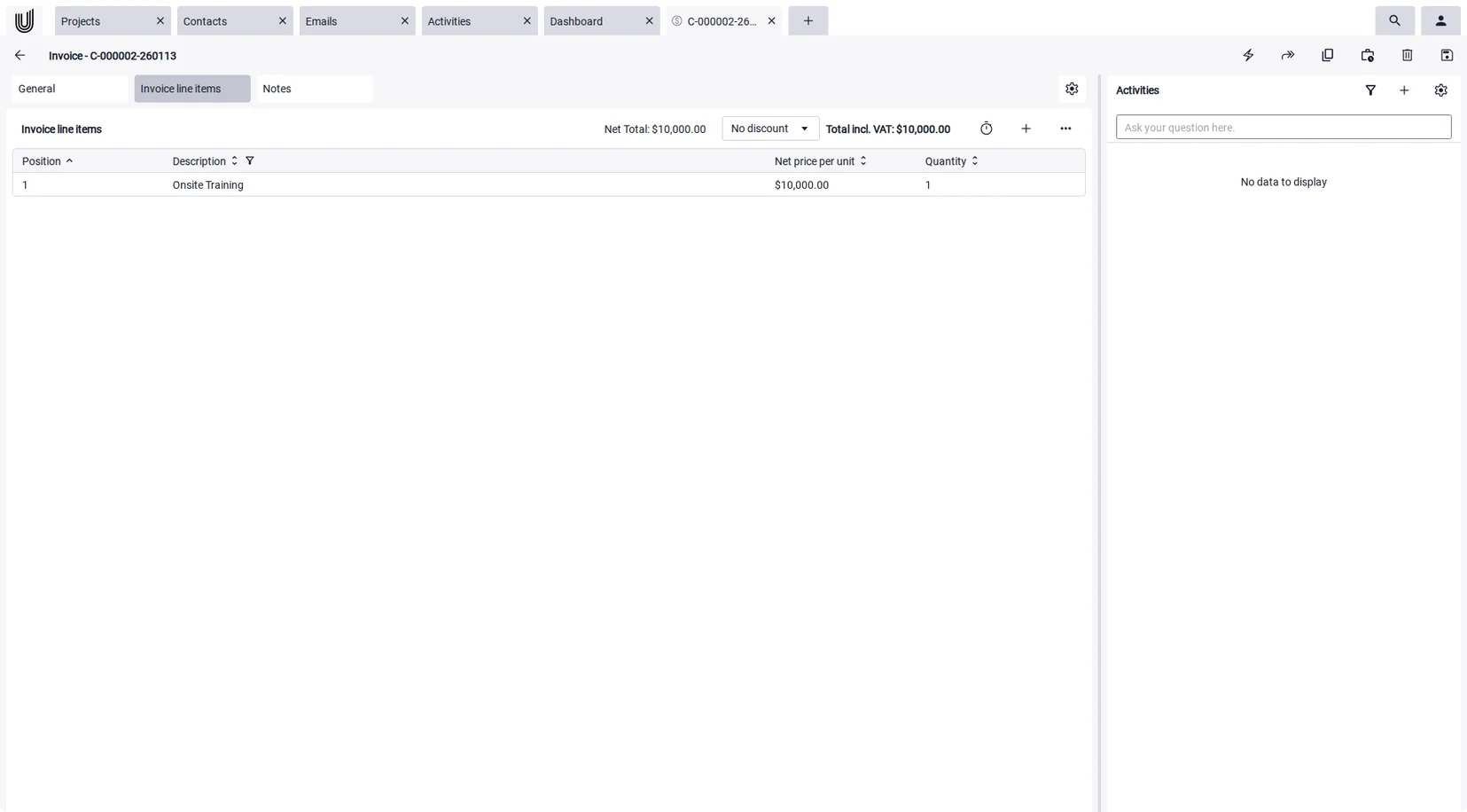
- Add line items: Insert products from the catalog, or transfer tracked working time automatically: select the project and time range, set the rounding, done. Discounts work as a fixed amount or percentage.
- Review: The preview shows the fully composed invoice. Net, gross, and VAT amounts are calculated automatically using fixed rounding rules.
- Send: The invoice goes out by email directly from the software. The recipient receives the readable invoice together with the machine-readable X-Invoice document, optionally with purchase terms attached.
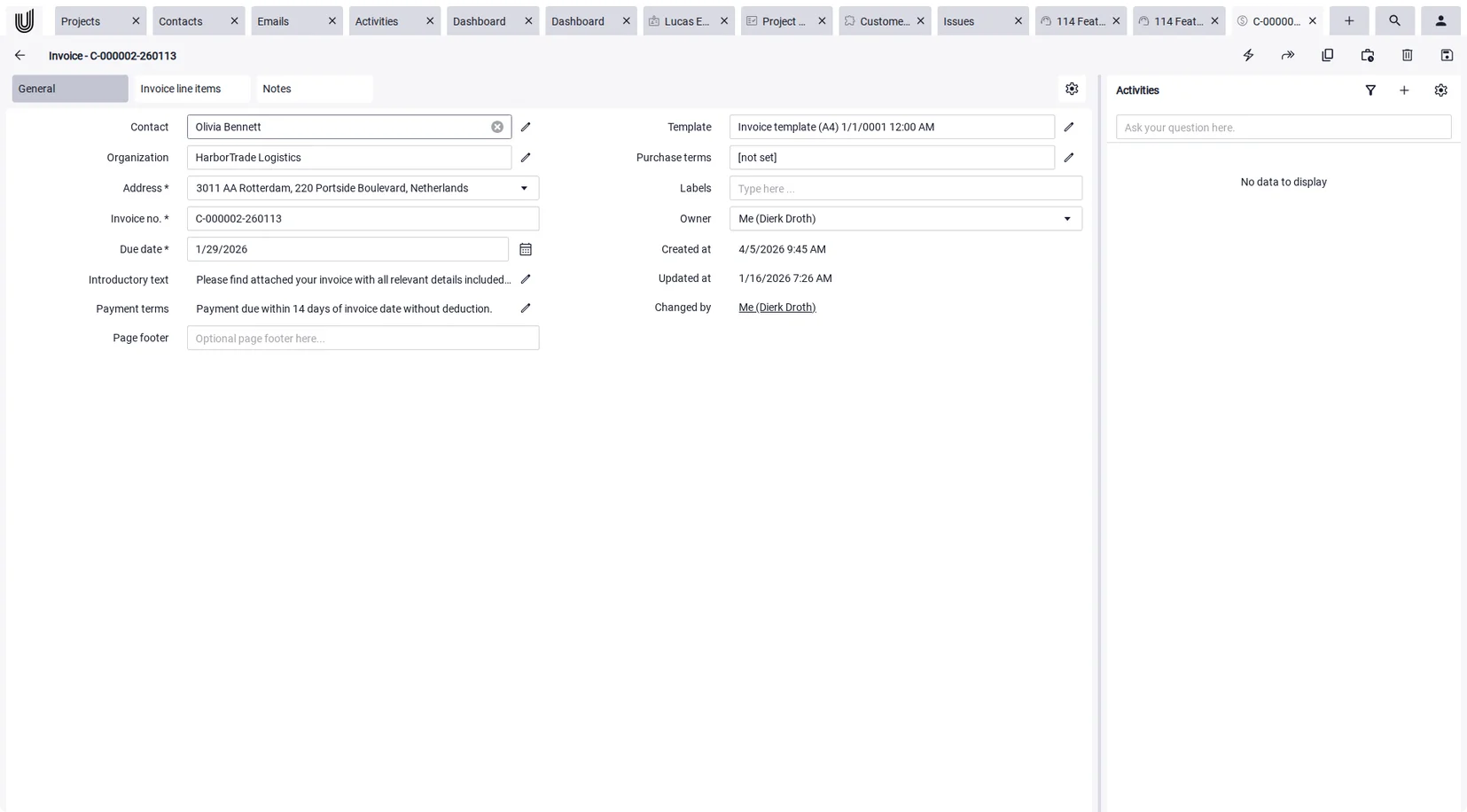
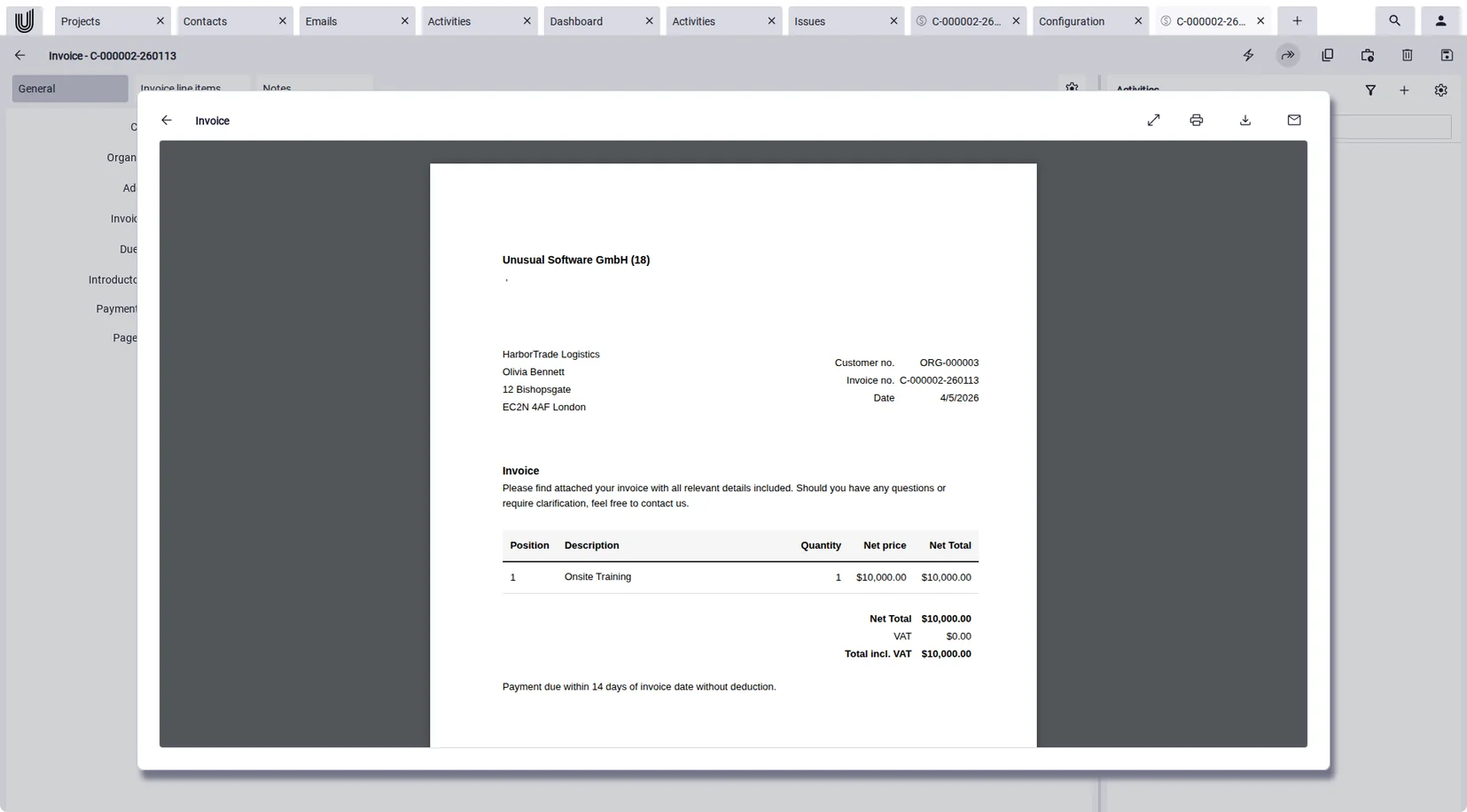
The appearance comes from templates: pick a ready-made standard template or upload your own HTML design in your corporate identity once, and reuse it for every future invoice, so each e-invoice looks consistent without redesigning it each time.
Recurring details such as company name, address, logo, or IBAN are filled in automatically through variables, so you don't retype them on every invoice. The accompanying email can be saved as a template too, and cancellation invoices are supported as well, so corrections stay clean and traceable.
Outside the EU: invoicing without a mandate
In a market without an e-invoicing mandate, such as the United States, you don't need a structured format at all, and the same workflow still applies. Unusual Suite creates professional invoices from your contacts, projects, and tracked time and sends them as a PDF or your own HTML design by email, in your currency. XRechnung output is available whenever an EU customer or public authority requires it.
The real advantage is the same everywhere: the invoice is built from data already in your CRM and time tracking, instead of being retyped from separate tools. That is where an integrated platform saves the most time, mandate or not.
Conclusion: Introduce E-Invoicing Early, and Integrated
E-invoicing mandates don't arrive unannounced; they come with clear timelines. Businesses that switch now avoid deadline pressure and gain the format's actual benefit: automated processing instead of retyping, on both sides of the invoice.
When choosing the software, look beyond the format. EN 16931 compliance is mandatory, but the difference in daily work comes from the data source: creating an electronic invoice takes minutes when customers, services, and hours are already in the system, and considerably longer when they have to be gathered from three different tools.
If you're already running separate tools for CRM, projects, and billing, treat the e-invoicing mandate as an occasion to review the whole process rather than adding yet another tool to the stack.
All-in-one platform
with compliant e-invoicing.
Bring customers, projects, tracked time, and e-invoices together in one business management software that combines invoicing with CRM, project management, and time tracking.
Try for freeElectronic Invoicing Software FAQ
Electronic invoicing software creates invoices in a structured electronic format based on the EN 16931 standard, such as XRechnung or ZUGFeRD. It handles the technical formatting, calculates amounts and VAT, and sends the invoice together with the machine-readable data record. A plain PDF from a word processor does not qualify as an e-invoice.
It depends heavily on the country. In Germany, all domestic businesses have had to be able to receive e-invoices since January 1, 2025; the requirement to issue them is being phased in, with full B2B coverage from 2028. Italy has required B2B e-invoicing since 2019, Belgium since January 2026, with Poland and France phasing their mandates in during 2026, and EU-wide cross-border B2B becomes mandatory from 2030. Latin American countries such as Mexico, Brazil, and Chile have required it for years. The United States, by contrast, has no federal B2B mandate, so there e-invoicing remains voluntary.
In Germany, small businesses under the section 19 UStG scheme are permanently exempt from issuing and may keep sending paper or PDF invoices. They must still be able to receive and retain an e-invoice, because the receiving duty applies to all businesses. Low-value invoices up to 250 EUR and invoices to private consumers are also exempt from the issuing duty.
For individual invoices, free web generators or government portals are enough. For ongoing business, use software that produces the format automatically: enter the recipient and line items, review the preview, and send. In integrated platforms like Unusual Suite, the line items come directly from tracked working time and the product catalog, with no duplicate entry.
XRechnung is a pure XML data format and the required standard for invoices to German public authorities. ZUGFeRD combines a readable PDF with embedded XML data in one file. UBL is an international XML syntax used by many national systems and the Peppol network. All of them implement the EN 16931 standard in their current versions, so all of them qualify as electronic invoices where the European rules apply.
There is no universal answer; the right choice depends on your focus and your market. Businesses that need full bookkeeping are well served by accounting suites such as QuickBooks, Xero, or Zoho Books. For invoicing alone, dedicated tools like FreshBooks or Wave are enough, while AP automation tools such as Bill.com or Tipalti focus on processing incoming invoices. Service businesses that bill projects and tracked hours benefit from all-in-one platforms such as Odoo or Unusual Suite, because the invoice data is already in the system. More important than the best tool is that the software produces the e-invoice format your customers and country require, and fits your process.